Nigeria Housing Market & Inventory Analysis
Completed Project
Data Analytics.
- Microsoft Excel.
- Estate Market & Inventory Analytics.
- KPI Cards.
- Pivot Table.
- Dashboard Design.
Business Problem
I discovered that Nigeria’s premium housing market was highly concentrated in a few locations, creating an imbalance in both property value and inventory. I found that investment activity and housing prices were dominated by a small number of states and micro markets, limiting market diversification and exposing the business to geographic concentration risk.
Key Results & Insights
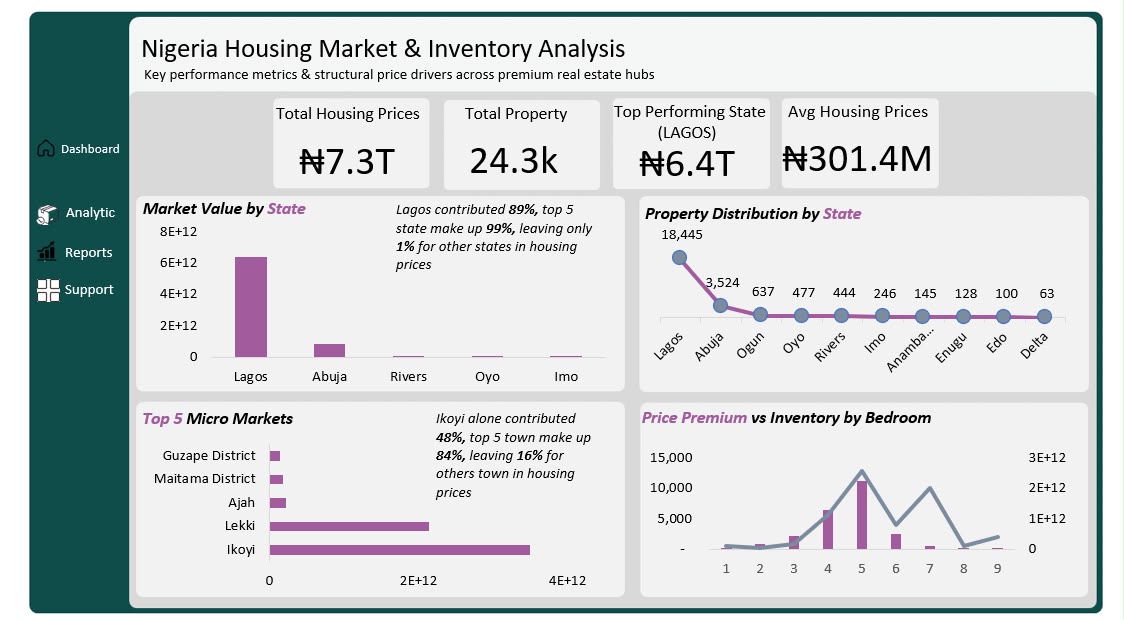
- ₦7.3T total market value analyzed across a portfolio of 24.3k properties, with an average listing price of ₦301.4M.
- Lagos dominates the ecosystem, single-handedly driving 89% (₦6.4T) of total market value and holding 18,445 properties.
- 99% value concentration sits within just the top 5 states, leaving a mere 1% for the rest of the country.
- Ikoyi is the ultimate premium driver, contributing 48% of total market value, while the top 5 micro-markets account for 84% of aggregate wealth.
What I Did
- Cleaned and structured a dataset of 24.3k properties to normalize prices, locations, and bedroom configurations.
- Built the Nigeria Housing Market & Inventory Analysis Dashboard to track macro-level state metrics and micro-market variations.
- Mapped market values and inventory distributions across competing states, isolating Lagos and Abuja as the dominant hubs.
- Segmented neighborhood performance to rank the top 5 high-yield micro-markets (Ikoyi, Lekki, Ajah, Maitama, and Guzape).
- Analyzed property configurations by cross-referencing bedroom counts against structural price premiums to evaluate development trends.
- Delivered data-driven real estate insights proving market high-concentration, enabling investors to maximize ROI by target-funding specific high-end luxury nodes.